

What is Archive? Archive pages are the listing pages WordPress builds for you, grouping posts by category, tag, author or month. Your theme decides how they look, and most themes keep them simple. With the archive template types in the Master Addons Theme Builder you design these pages…
Archive pages are the listing pages WordPress builds for you, grouping posts by category, tag, author or month. Your theme decides how they look, and most themes keep them simple. With the archive template types in the Master Addons Theme Builder you design these pages in Elementor, with a proper header for the category name and a post grid that matches the rest of your site.
Pick the right archive type #
The Theme Builder has a separate template type for each kind of archive, all listed under the Archive group:
- Category for category pages, such as
/category/news/. - Tag for tag pages.
- Author for author pages, which list everything one person wrote.
- Date for monthly and yearly archives.
- All Archives, a general archive type.
Create the type that matches the page you want to change. In our tests with Master Addons 3.2.3, an All Archives template did not replace category, tag, author or date pages or the blog page, so use the specific type for those. This guide builds a Category template. The steps are the same for Tag, Author and Date.
Before you start #
- Install and activate Elementor and Master Addons.
- The archive template types are part of Master Addons Pro. The free version lists them with a “(Pro)” label.
- Add a description to your categories under Posts > Categories if you want to show one on the page.
Step 1: Create a new template #
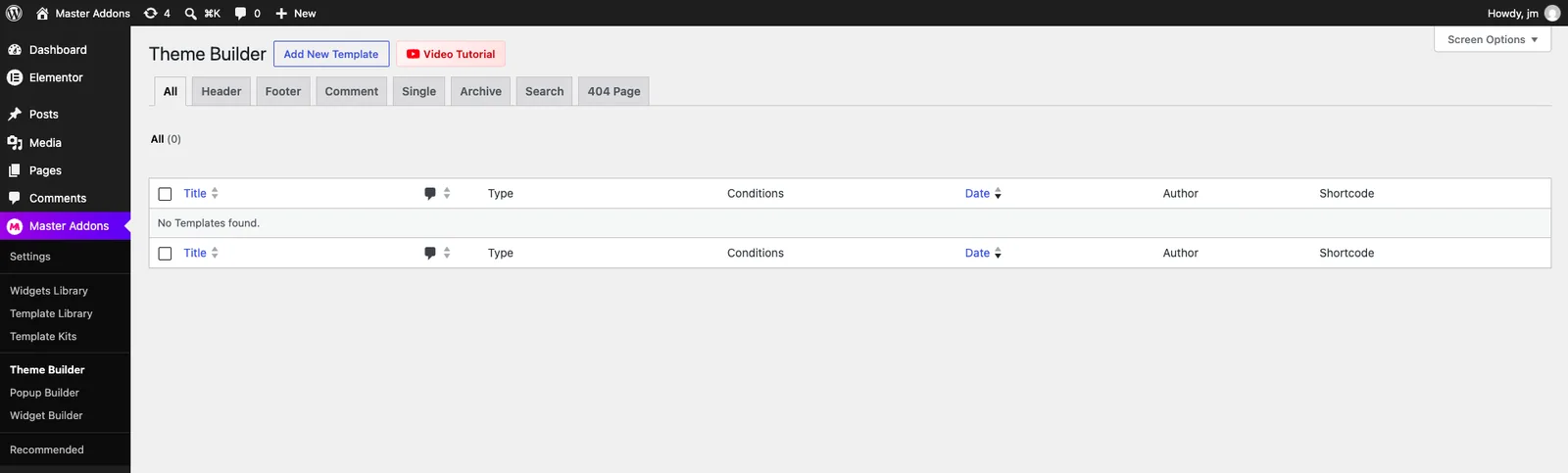
Go to Master Addons > Theme Builder and click Add New Template.
Step 2: Choose the Category type #
On the General tab of the dialog:
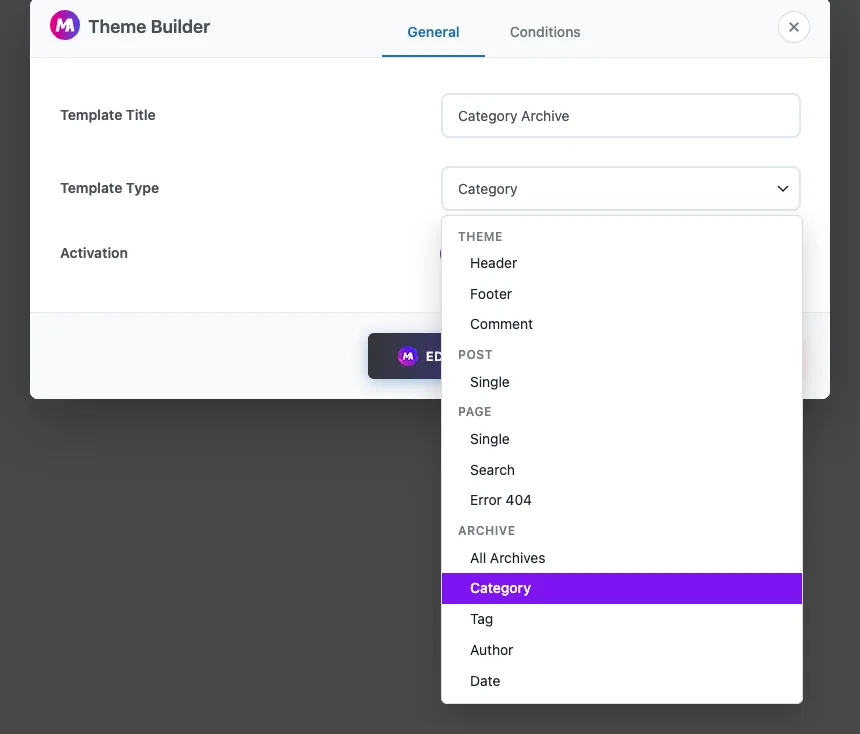
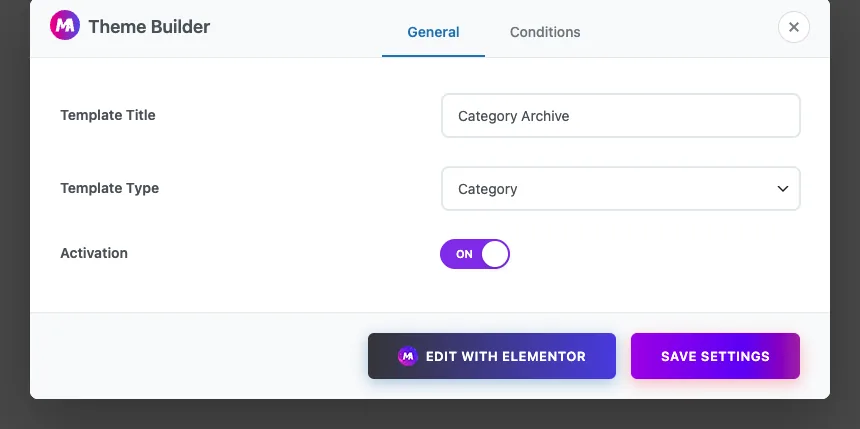
- Template Title: any name you’ll recognize, such as “Category Archive”.
- Template Type: choose Category from the Archive group.
- Activation: switch it ON.
Step 3: Check the condition #
Open the Conditions tab. A new Category template gets the condition Include > Archive > Category Archive, so it covers every category page on the site. The third dropdown also offers All, Author Archive, Date Archive and Tag Archive. A new template gets the option that matches its type, but if you change the type of an existing template later, set this dropdown to match yourself.
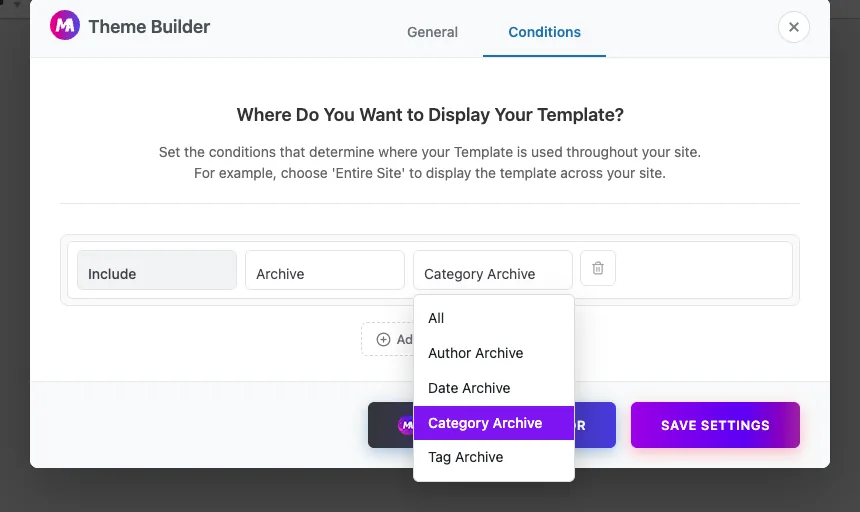
The condition covers all categories at once. You can’t pick one specific category here.
Click Save Settings, or Edit with Elementor to open the template in the editor.
Step 4: Add the archive title and description #
Master Addons adds its own dynamic tags to Elementor. Click the dynamic tags icon on any text field and look for the Archive group: Archive Title, Archive Description and Archive Meta. The Author group has Author Name, Author Info and Author Meta for author archives.
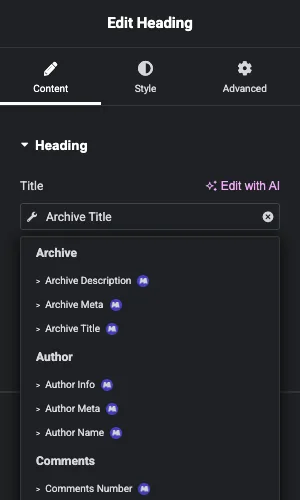
For the header of the page:
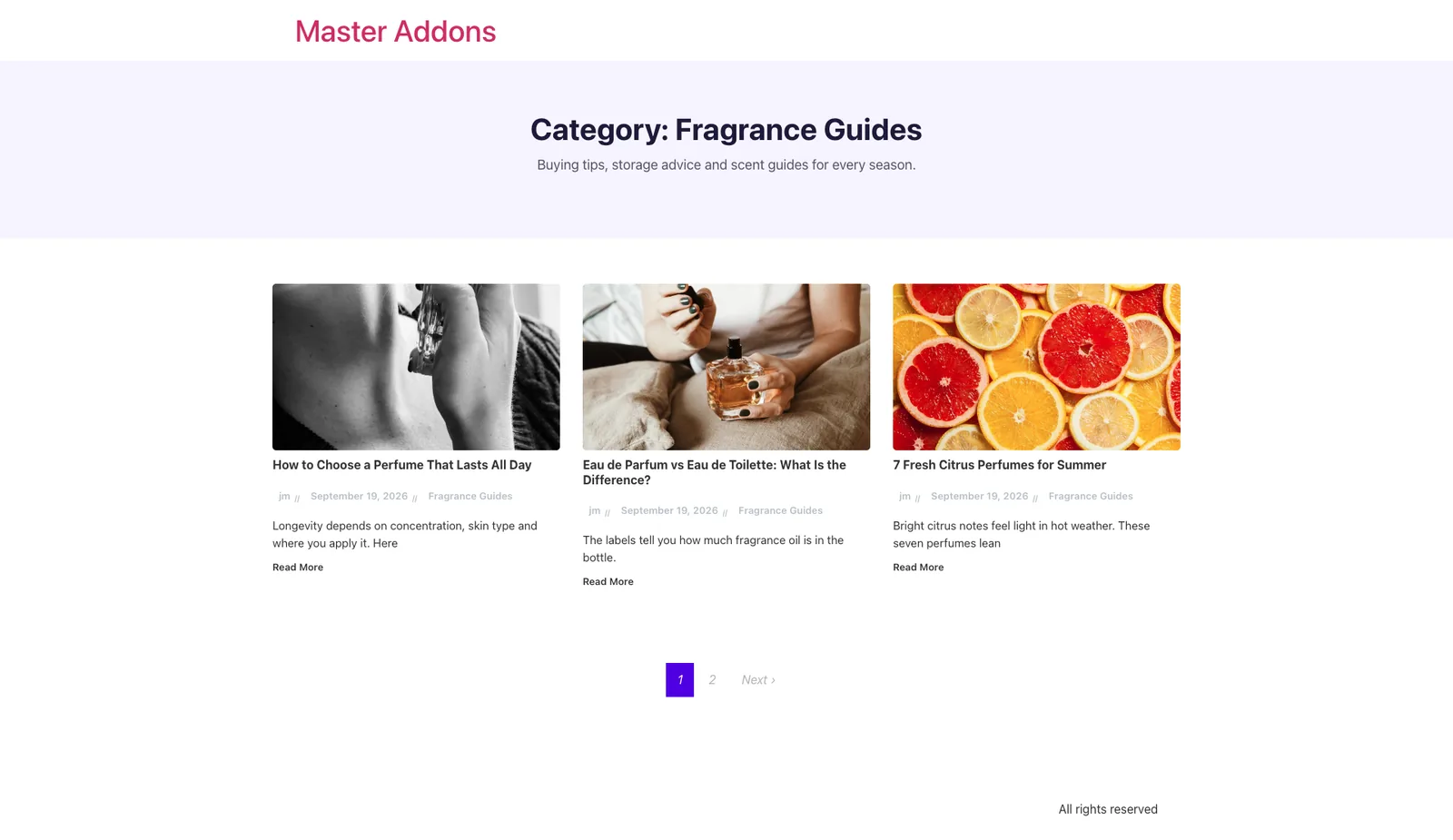
- Add a Heading widget and set its Title to the Archive Title tag. With Include Context on, it reads “Category: Fragrance Guides”. Turn it off to show only “Fragrance Guides”.
- Add a Text Editor widget below it and set its content to the Archive Description tag. It shows the description you wrote for the category.
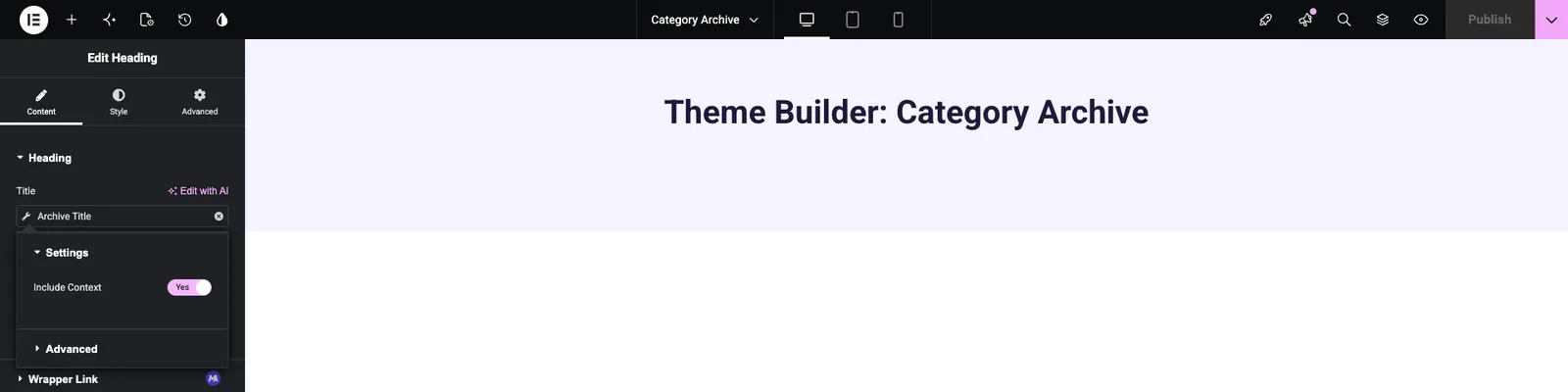
In the editor these tags can’t know which category a visitor will open, so the heading shows the template’s own name, such as “Theme Builder: Category Archive”, and the description stays empty. The real category name and description appear on the front end.
Step 5: List the posts with Blog Posts #
Add the Master Addons Blog Posts widget below the header. In Display Options, set Source to Current Query. The widget then lists the posts of whichever category the visitor is looking at, instead of your latest posts.
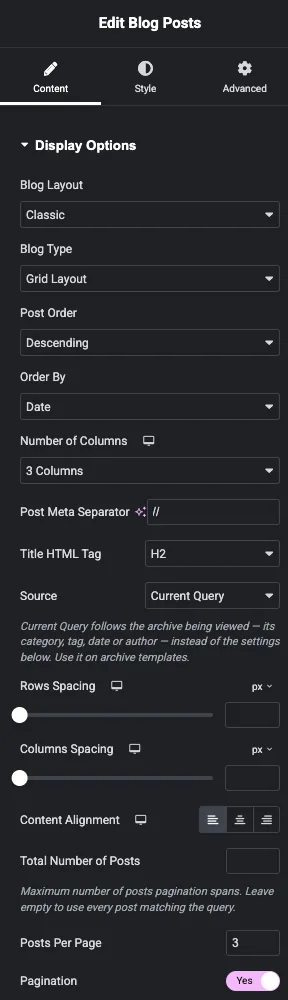
The other settings control the layout: Number of Columns for the grid, Posts Per Page for how many posts each page shows, and Pagination for page links. Thumbnail Settings and Posts Settings let you show or hide the image, excerpt, date, author and categories.
The editor preview of this grid won’t match the live page, for the same reason as the heading. Check it on the front end, then click Publish.
Step 6: Confirm the template is active #
Go back to Master Addons > Theme Builder. The template shows type Category, a green Active badge and the condition Include > Archive > Category. Category, Tag, Author and Date templates are listed under the All tab; the Archive tab only shows All Archives templates.

Step 7: Test it on a category page #
Open any category on your site, for example from a category link under a post, or at yoursite.com/category/your-category/. With Plain permalinks the address looks like yoursite.com/?cat=4. You should see the category name, its description and a grid of that category’s posts with page links underneath.
Also open a tag or author page. Those keep your theme’s layout until you create a Tag or Author template for them.
Tips #
- Build an Author template the same way and add the Author Name and Author Info tags to the header, so each author page opens with a short bio.
- Keep one active template per type. If two Category templates are on, Master Addons uses the most recently created one.
- Write short category descriptions. The Archive Description tag shows them as they are, and a single sentence reads best under the title.
- Set Posts Per Page to a multiple of your column count so the last row is full.
Frequently asked questions #
Are archive templates free? #
No. Category, Tag, Author, Date and All Archives templates are part of Master Addons Pro. Header, Footer and Comment templates are free.
Why didn’t my All Archives template change my category pages? #
Category, tag, author and date pages each look for a template of their own type. Create a Category template for category pages, a Tag template for tag pages, and so on.
Can I use a different design for one category? #
Not with the built-in conditions. The Category Archive condition applies to every category at once.
Why does the editor show the template name instead of the category? #
The editor has no category to read, so the Archive Title tag falls back to the template itself. Open a real category page to see the final result.
Where does the category description come from? #
From the Description field of each category under Posts > Categories. If a category has no description, the Archive Description tag shows nothing.
Wrapping up #
To design your archive pages, create a template of the matching type under Master Addons > Theme Builder, add the Archive Title and Archive Description tags to the header, and list the posts with Blog Posts set to Current Query. Repeat for tags, authors or dates as needed. For related templates, see the Single, Search and 404 guides, or read more about the Master Addons Theme Builder.


