

Some pages need to show right now: the current date on a booking page, a timestamp on a status board, today’s date in a header bar. The free Current Time widget in Master Addons for Elementor prints the site time in any format, from a raw Unix timestamp to “July 4, 2026 10:36 am”, styled like any other Elementor text.
It is one of the smallest widgets in the plugin, and this guide covers all of it: the three time types, the format strings, and the styling.
What the Current Time widget does #
The widget outputs the current date and time as text, generated fresh on each page load. You choose what it looks like with the Type of time setting, and the Style tab handles color, shadow, and typography. That’s the whole widget, which is exactly why it’s useful: no shortcode, no code snippet, just the time where you drop it.
Before you start #
- WordPress with Elementor installed and active.
- Master Addons for Elementor installed and active. New to the plugin? See the installation guide.
- The Current Time widget enabled in the Master Addons option panel, under Dynamic Widgets.
- Your WordPress timezone set correctly under Settings, General. The widget prints the site’s time, so a wrong timezone shows a wrong clock.
How to add the Current Time widget #
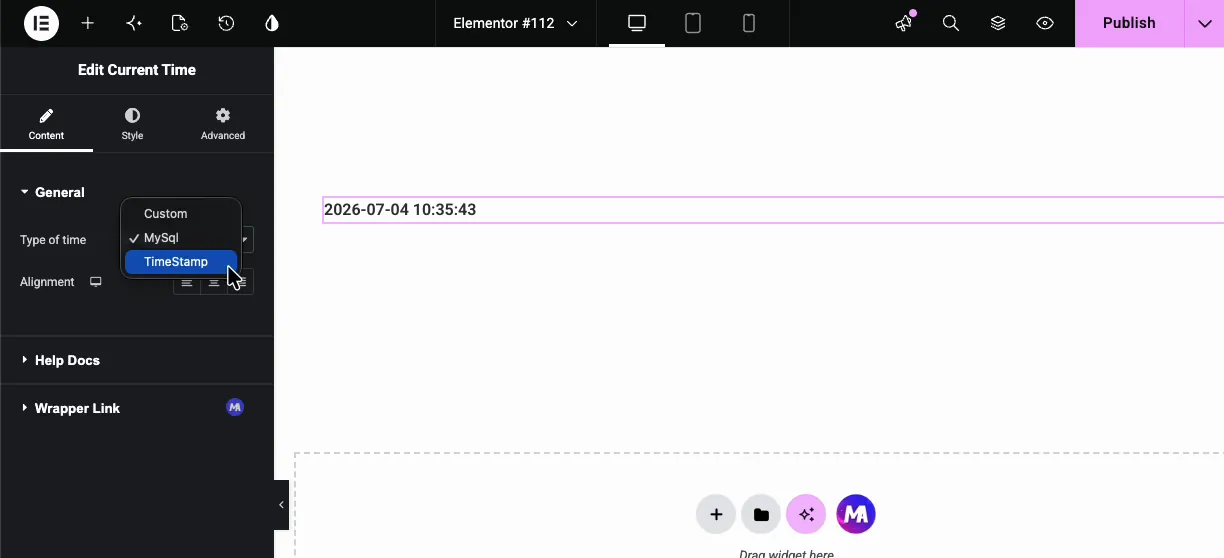
In the Elementor editor, search the Elements panel for Current Time and drag it onto the page. It prints the time immediately in the default MySql format, like 2026-07-04 10:35:43, ready to be reformatted.
Pick the time type #
The General section has two controls: Type of time and Alignment. The type dropdown offers three outputs: MySql, the default, prints a database-style datetime like 2026-07-04 10:35:43; TimeStamp prints the raw Unix timestamp, the number of seconds since 1970; and Custom takes any format you define. Here is TimeStamp on the canvas:
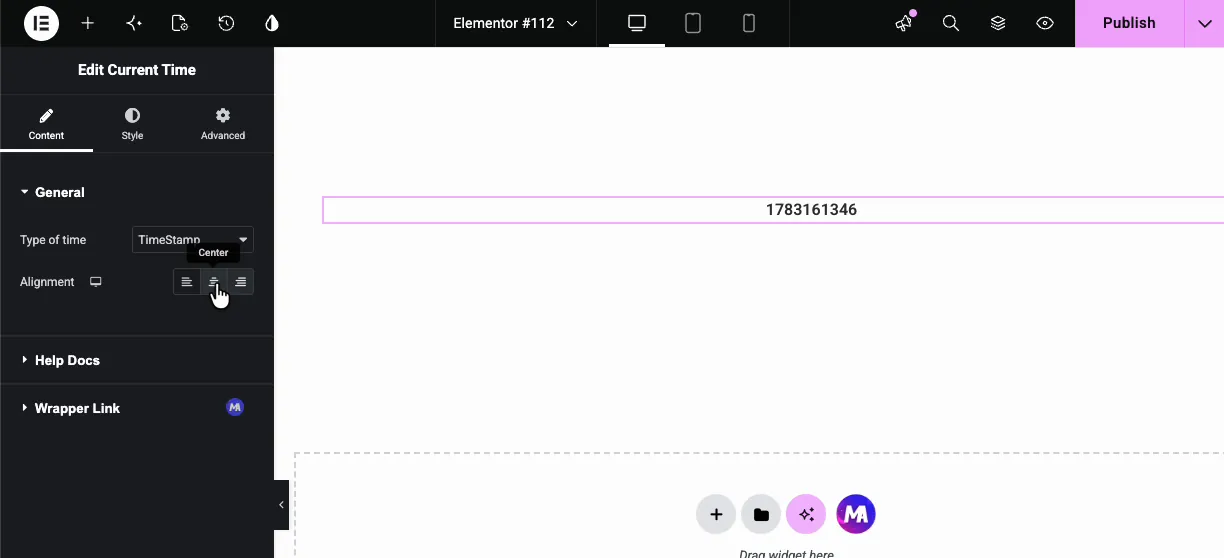
A timestamp suits technical pages and countdown integrations. For anything visitors actually read, switch the type to Custom; nobody wants to do the seconds-since-1970 math.
Build a custom date format #
With Custom selected, a Date Format String field appears. It takes standard PHP date format characters: the demo’s F j, Y g:i a renders as “July 4, 2026 10:36 am” on the canvas the moment it’s typed.
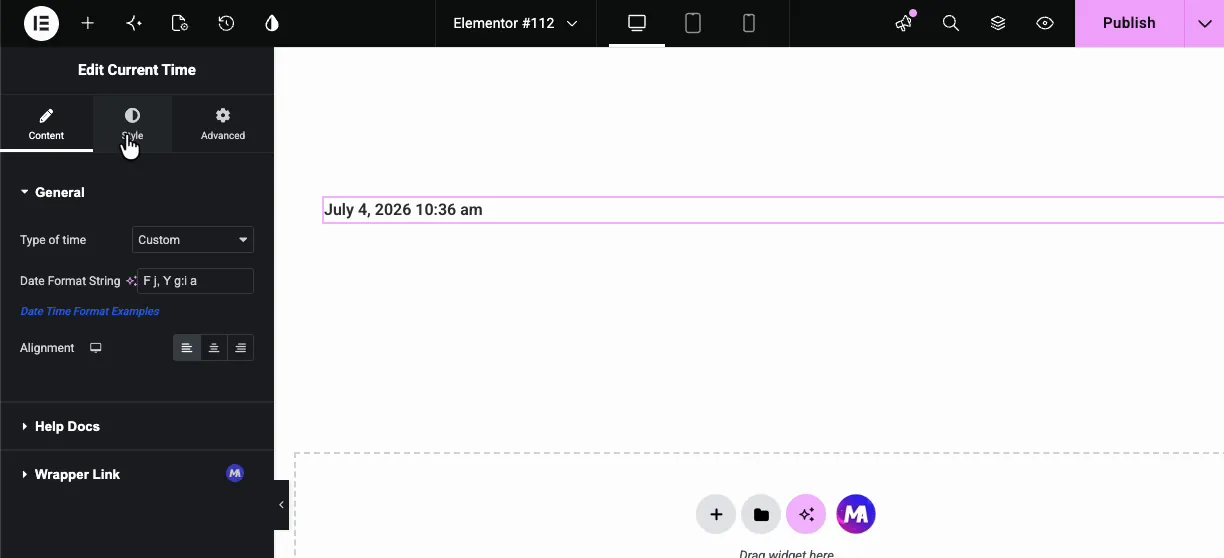
The Date Time Format Examples link under the field opens a reference of ready-made strings with their output, so you can copy one instead of memorizing PHP format characters:
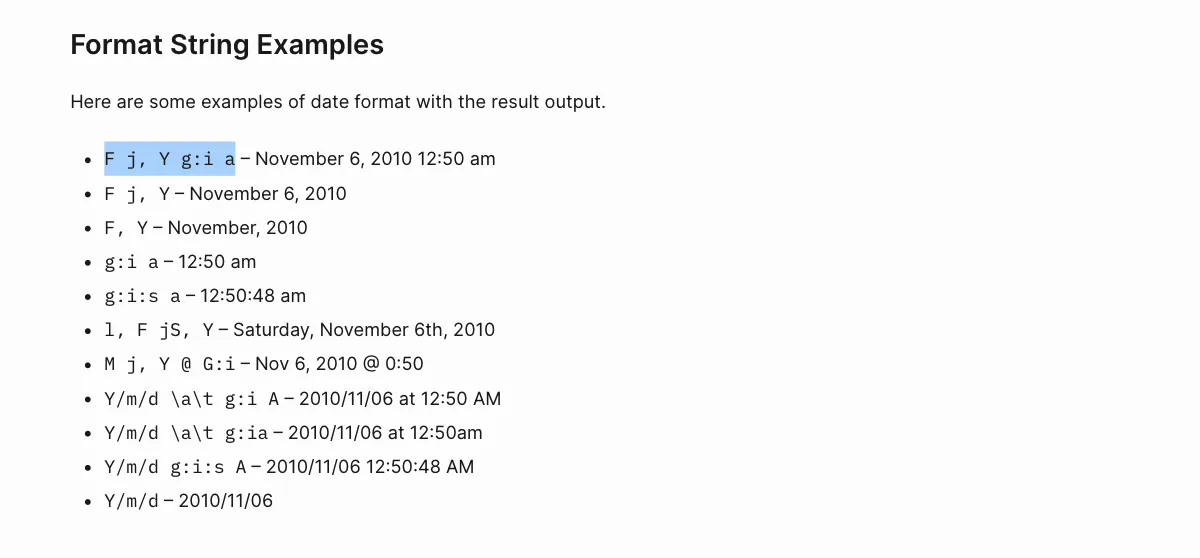
A few from the list:
F j, Y g:i a— November 6, 2010 12:50 amF j, Y— November 6, 2010g:i a— 12:50 aml, F jS, Y— Saturday, November 6th, 2010Y/m/d— 2010/11/06
Style the output #
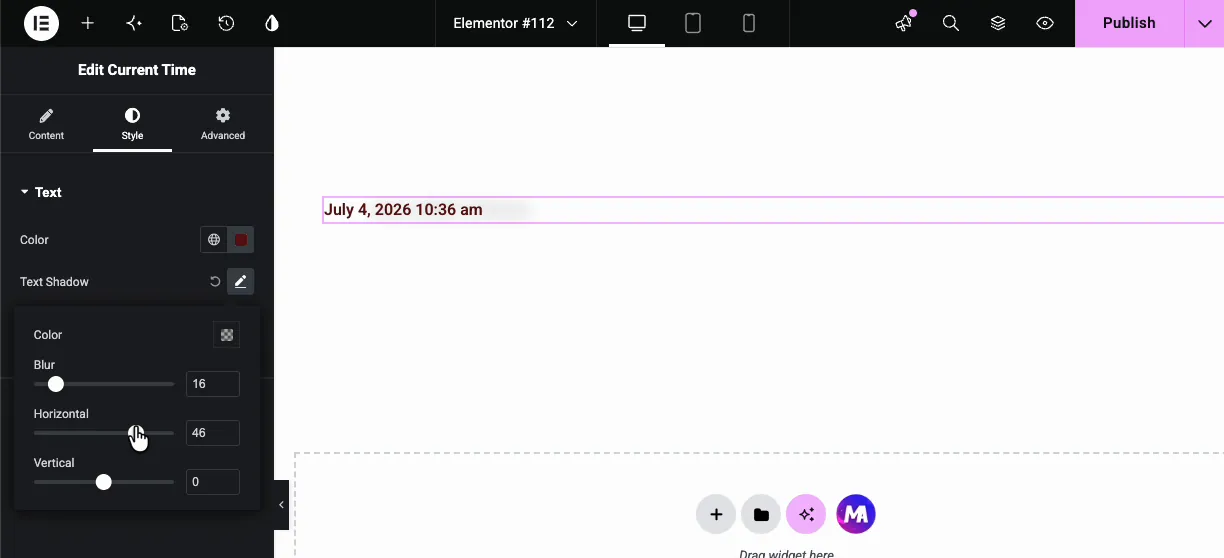
The Style tab has one section, Text, with three controls. Color sets the text color, and Text Shadow adds blur and offset when the time sits over an image:
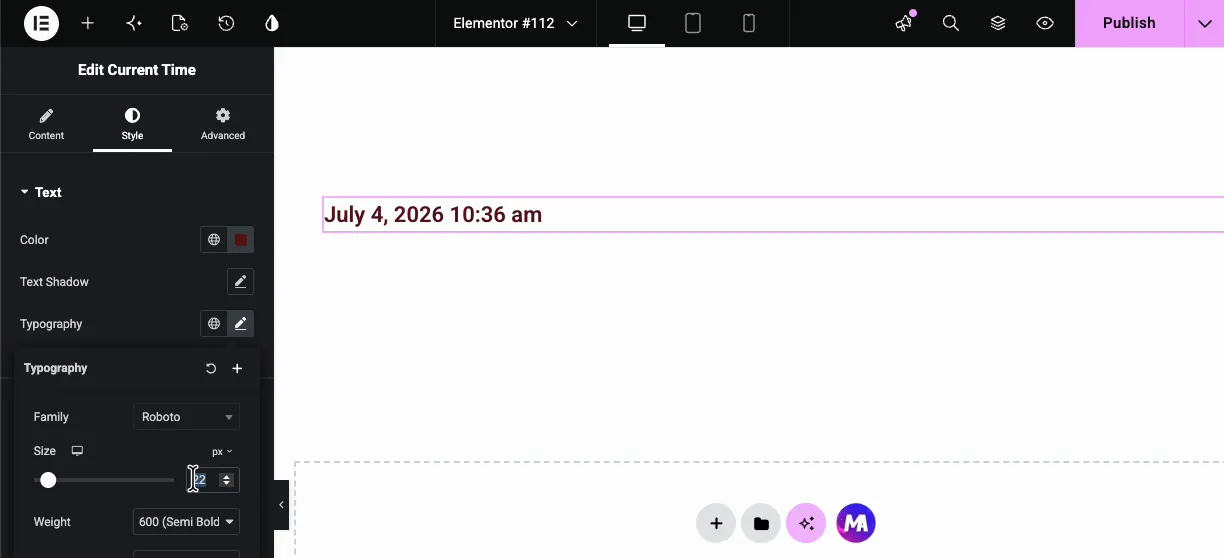
Typography covers family, size, and weight. The demo sets Roboto at semibold, turning the plain line into something that holds its own in a header:
The result on the page #
The published page prints the live date and time in your format and style, fresh on every load:

Common use cases #
- Header and topbar dates on news and magazine sites.
- Booking and reservation pages showing today’s date beside the form.
- Status and dashboard pages with a “as of” timestamp.
- Countdown and offer sections pairing the current date with a Countdown Timer.
- Print-friendly pages like quotes and invoices that should carry the day they were viewed.
Tips for using the widget #
- Fix the timezone first. The widget prints WordPress’s clock; if the site timezone is UTC, so is the widget. Settings, General, Timezone.
- Copy from the examples page. The format reference linked under the field covers the common layouts; start there and adjust.
- Escape literal letters. In PHP date strings, letters are format codes. The reference’s
Y/m/d \a\t g:i Ashows how a literal “at” gets backslashes. - Mind caching. The time renders on page load, so a page cached for an hour shows an hour-old time. Fine for dates, misleading for a clock.
- Keep the format short in headers. “July 4, 2026” fits a topbar; the full date-plus-time string wants a wider spot.
Video Tutorial #
If you’d like to see the Current Time widget in action, this short video covers the whole setup, from the default output to the styled custom date:
Frequently Asked Questions #
What is the Current Time widget in Master Addons?
It is an Elementor widget that prints the live date and time as text. Choose the MySql datetime default, a raw Unix timestamp, or a Custom type with any PHP date format string, align it, and style the color, shadow, and typography from the Style tab.
How do I change the date format?
Set Type of time to Custom and type a PHP date format string in the Date Format String field. For example, F j, Y g:i a renders as July 4, 2026 10:36 am. The Date Time Format Examples link under the field lists ready-made strings.
What timezone does the widget use?
It uses your WordPress site timezone from Settings, General. If the displayed time looks wrong, correct the timezone there rather than in the widget; the widget has no separate timezone setting.
Does the time update live on the page?
The time is generated when the page loads, so each visit shows the current time at that moment. It does not tick forward like a clock while the visitor stays on the page, and cached pages show the time the cache was built.
Can I show only the date without the time?
Yes. Use a format string without time characters, like F j, Y for July 4, 2026 or Y/m/d for 2026/07/04. Any combination of PHP date characters works, so the output can be as short as a year.
Wrapping up #
The Current Time widget does one job cleanly: the live date and time, in any format PHP can express, styled like native Elementor text. Set the site timezone, pick or copy a format string, and it runs itself. Browse the full set of Master Addons widgets and extensions for the rest of the dynamic widgets, and see the Current Time widget page for demos.


